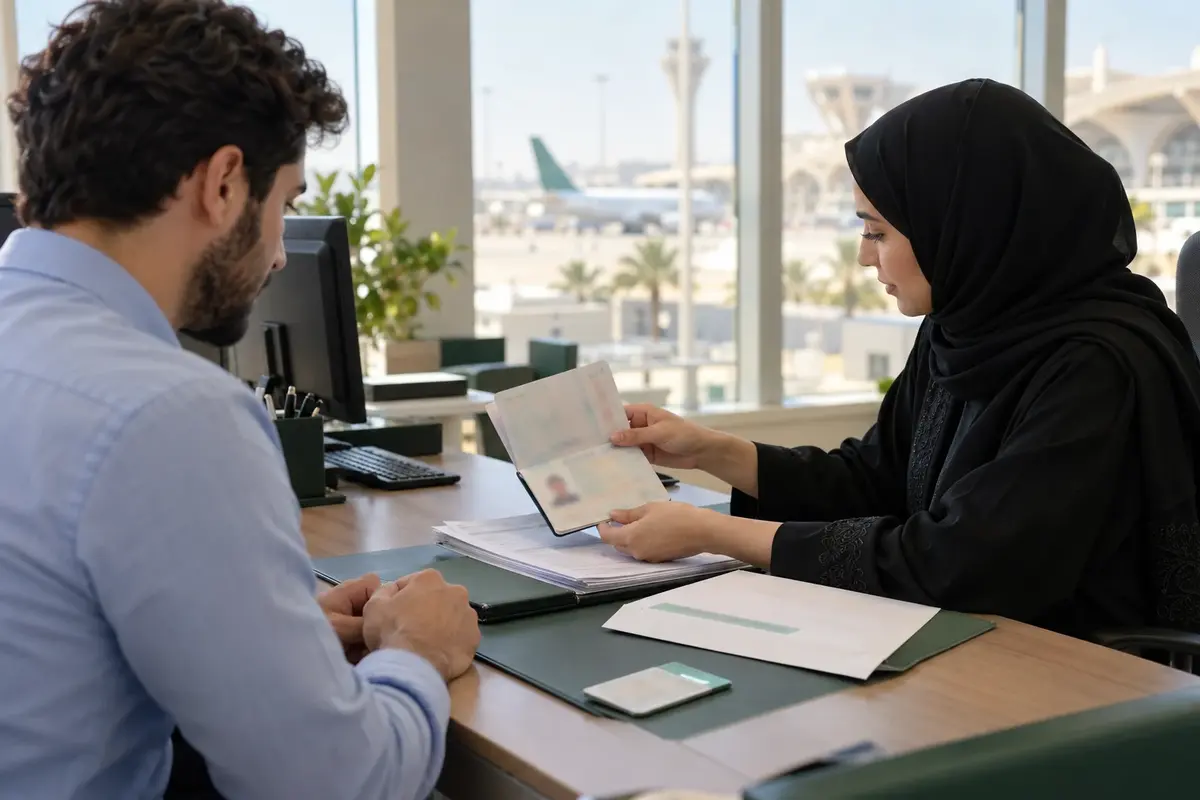
Know who completes the first-Iqama transaction
A first Iqama for an establishment employee is not a personal application that a newly arrived worker completes independently. Absher Business describes its issuance service as a service for the establishment owner to issue a Resident Identity for workers. HRSD separately describes the work permit as one of the conditions for issuing or renewing regular residency.
Your practical role is to provide accurate documents, complete any personal enrolment requested through an official channel, and review the result. The employer or its authorized representative handles the establishment-side work-permit and residency transactions. For a family member or registered domestic worker, Absher Individuals uses a different route, so do not follow a household guide for a company employee.
Prepare one consistent set of personal records
Give HR a clear copy of the passport and the entry or border details they request. Check the English and Arabic spelling of your name, passport number, nationality, date of birth and occupation against the source documents. If a passport was replaced after the employment process began, tell HR instead of assuming the new number has automatically reached every system.
Keep a private checklist showing what you supplied and on which date. Do not send passport or border-number images through a public comment or an unofficial messaging account. If HR says a biometric, medical or insurance step is incomplete, ask for the exact official service or status that is blocking the transaction rather than paying a third party who promises to bypass it.
Confirm the work permit before asking about the Iqama
HRSD states that establishments issue work permits for expatriate employees through Qiwa and that a work permit is a condition for regular residency. Its service page says the establishment selects the worker, submits the request and pays with the generated payment number. It also says the facility must issue the permit within the first 90 days after the employee enters Saudi Arabia.
The same page warns that system updates can take time: it describes an approximate one-hour update after payment in Qiwa and up to 24 hours for the payment status to appear in passport systems. If HR has just paid, distinguish a normal synchronization delay from a rejected application. Ask for the request or payment reference and the current status rather than submitting duplicate payments.
Do not accept employer fees as your personal obligation
HRSD's official worker-rights guidance says the employer bears recruitment fees and the fees for issuing and renewing the Iqama and work permit, along with fines caused by delay and the fee for changing profession. That rule is important when a worker is asked to reimburse an establishment transaction without an explanation.
Keep any written request for payment and ask HR to identify the legal or contractual basis. Do not confuse optional personal expenses, such as obtaining your own extra copies, with the statutory employer-side issuance fees. If there is a dispute, use an official labour-support or complaint channel and provide the request, employment details and payment evidence privately.
Track issuance and check the identity immediately
Once prerequisites are satisfied, the authorized establishment user completes the Iqama issuance in Absher Business. Ask HR for confirmation that the transaction was completed, not only that a payment was made. A paid work permit and an issued Resident Identity are connected steps but they are not the same status.
When the identity becomes available, compare the name, passport link, occupation and other visible details with your records. Report an error promptly through HR so the correct official correction service can be identified. Do not edit a downloaded record or create an unofficial card image. Keep the first issued copy and any correction reference in a secure personal folder.
Use the linked SPL government-document delivery route
SPL lists Iqama issue and renewal among Ministry of Interior documents that can be delivered. Its instructions say the request begins in Absher, uses the registered National Address, and is followed by an SMS with receipt and payment information. SPL's FAQ states a general delivery timeframe of three to five working days after it receives the document from the source.
Treat delivery as the final logistics step, not proof that the Iqama issuance itself succeeded. Check that your National Address is current, retain the shipment number from the official message, and track it on SPL. Be cautious with links demanding payment outside Absher or SPL, and never publish a shipment number alongside your Iqama or address.
If the document does not arrive within the stated service window, check whether SPL has actually received it before opening a delivery complaint. Give support the shipment reference, not a public copy of the Iqama.