Common reasons travel bans are issued against expats in the UAE
A travel ban (منع من السفر) is an official legal order prohibiting an individual from leaving the country or entering UAE ports of entry. For expatriates, finding out about a travel ban at Dubai International Airport (DXB) or Zayed International Airport (AUH) results in missed flights, confiscated passports, and potential police detention.
The most frequent catalysts for UAE travel bans include:
1. Financial & Banking Claims: Unpaid bank loans, defaulted credit cards, or bounced security cheques where financial institutions file civil or execution proceedings under UAE Commercial Transactions Law.
2. Employment & Absconding Reports: Employers filing an official 'Absconding from Work' (Huroob / Inqita'a) report with MOHRE or immigration authorities following contract abandonment.
3. Unsettled Civil & Commercial Court Disputes: Outstanding commercial rental arrears filed with the Rental Dispute Settlement Centre (RDSC) or commercial judgments exceeding statutory thresholds.
4. Criminal Complaints or Investigations: Active police reports, ongoing public prosecution investigations, or unpaid court criminal fines.
5. Family & Child Custody Orders: Court-ordered restrictions issued in personal status and divorce cases preventing a parent from taking children outside the UAE.
Why you cannot rely on a single search: the 3 jurisdictional databases
A critical pitfall that traps thousands of UAE expats is searching only one website and falsely assuming they are cleared to fly. The UAE legal architecture is bifurcated across three distinct jurisdictions:
1. Dubai Emirate Jurisdiction: Dubai operates its own independent judicial and police apparatus (Dubai Courts, Dubai Public Prosecution, and Dubai Police). A clearance from Dubai Police only guarantees you have no active circulars registered in Dubai.
2. Abu Dhabi Emirate Jurisdiction: Abu Dhabi operates under the Abu Dhabi Judicial Department (ADJD) with its own specialized commercial and financial execution courts.
3. Federal Jurisdiction (Sharjah, Ajman, RAK, Fujairah, UAQ): The Northern Emirates fall under the federal UAE Ministry of Justice (MOJ) system.
Best Practice: If you have lived, worked, or held bank accounts across multiple Emirates, you must perform separate checks across each relevant portal before international travel.
How to check Dubai travel bans & financial circulars (Dubai Police)
Dubai Police provides a free, instant digital service to check whether you have active financial circulars or travel bans resulting from police reports in Dubai:
- 1
Download Dubai Police App or visit website
Open the official Dubai Police smart app (iOS/Android) or visit dubaipolice.gov.ae. Select 'Services' > 'Individual Services'.
- 2
Select 'Criminal & Financial Status in Financial Cases'
Locate the electronic service titled 'Circulars and Travel Bans In Financial Cases' (استعلام عن التعاميم والمنع من السفر للقضايا المالية).
- 3
Authenticate with UAE Pass or Emirates ID
Sign in securely via UAE Pass (digital national identity) or input your 15-digit Emirates ID number and date of birth.
- 4
Review the clearance status result
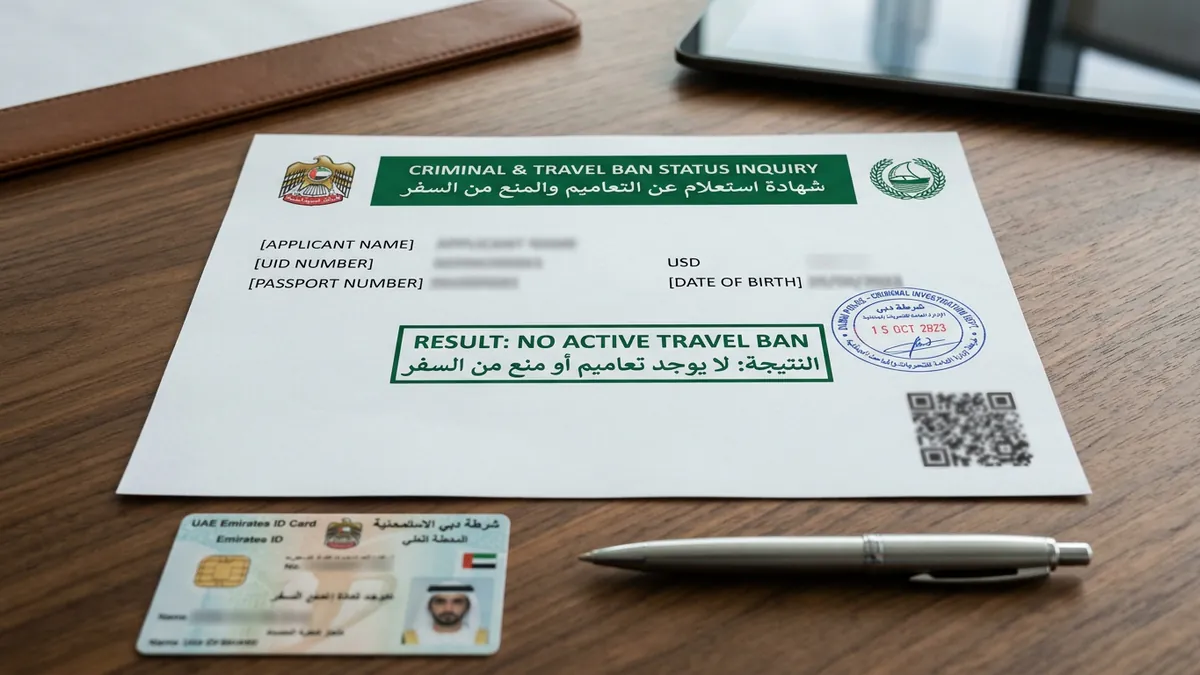
The system queries the central Dubai Police criminal investigation department (CID) database. If clear, a green status confirms 'No circulars or travel bans registered'. If an issue exists, the screen displays the specific police station and circular reference number.
How to check Abu Dhabi travel bans (ADJD Estafser Service)
For matters originating in the capital emirate, the Abu Dhabi Judicial Department provides the dedicated **Estafser** (استفسر) public enquiry tool:
1. Visit the ADJD portal at adjd.gov.ae or open the ADJD smartphone app.
2. Navigate to 'E-Services' > 'Public Inquiries' > select 'Estafser' (Enquire About Cases / Travel Bans).
3. Enter your Unified Number (UID) — the 9-digit number printed on your UAE visa page and Emirates ID.
4. Solve the security captcha and click 'Search'.
5. The portal queries the Abu Dhabi Public Prosecution and Court registry, detailing any active execution files, civil claims, or travel restrictions.
How to check Northern Emirates travel bans (UAE Ministry of Justice)
If you took a loan, signed a lease, or worked in Sharjah, Ajman, Ras Al Khaimah, Umm Al Quwain, or Fujairah, check via the federal judicial portal:
1. Open the official UAE Ministry of Justice portal at moj.gov.ae.
2. Go to 'E-Services' > 'Litigation Services' > select 'Inquiry About Travel Ban' (خدمة الاستعلام عن منع من السفر).
3. Sign in using your UAE Pass credentials.
4. The system scans all federal court registers and provides an immediate certificate confirming whether a judicial ban has been registered.
How to resolve and lift a travel ban before your flight
If an inquiry reveals an active travel ban, do not attempt to clear airport immigration. Take these verified remedial actions:
1. Settle Financial Claims: Contact the creditor bank or plaintiff to negotiate a settlement or clearance letter (No Liability Certificate).
2. Pay Through Court Execution Portals: If a court judgment exists, deposit the required amount into the court's escrow account via the Dubai Courts or ADJD electronic portal.
3. Electronic Cancellation Request: Upon full settlement, submit an electronic request titled 'Cancellation of Travel Ban' (طلب إلغاء منع من السفر) attaching payment receipts.
4. Immigration File Clearance: Once the judge approves the cancellation, the order transmits electronically to the police CID and ICP/GDRFA immigration gates; allow 24 to 48 business hours for airport border databases to synchronize before booking flights.